
Restaurant Loyalty Program ROI: What 10,095 Orders Reveal
Are restaurant loyalty programs worth it? See anonymized benchmarks from 10,095 orders and a practical formula for measuring repeat visits, reward cost and ROI.
Food Truck or Restaurant Owner? Sign up for the Culinary Entrepreneur Newsletter!
Is a restaurant loyalty program worth it? The honest answer is not “yes” or “no.” It is worth it when the incremental contribution profit from additional visits is greater than the cost of rewards, software, marketing and staff time.
That sounds simple, but most restaurant loyalty reports stop at enrollment, redemptions or member sales. Those numbers describe activity. They do not prove positive ROI.
To give operators a more useful starting point, we analyzed 10,095 loyalty-linked orders from 13 anonymous restaurant locations using Avocado. The early data shows promising repeat behavior and modest reward exposure, but it also shows why average order value alone can be misleading.
Disclosure: Avocado provides point-of-sale, loyalty, payment and reporting tools for restaurants. This analysis uses anonymized, aggregated platform data. No restaurant or customer is identified. The results describe observed behavior and should not be interpreted as a randomized experiment or a national restaurant benchmark.
Restaurant loyalty program results at a glance
Metric | Observed result |
|---|---|
Restaurant locations with loyalty activity | 13 |
Active loyalty members | 5,569 |
Loyalty-linked orders | 10,095 |
Gross basket sales on those orders | $199,162 |
Recorded menu value of loyalty rewards | $2,076 |
Reward value as a share of gross loyalty sales | 1.04% |
Members who returned within 30 days | 27.5% of the mature cohort |
Members who returned within 60 days | 41.1% of the mature cohort |
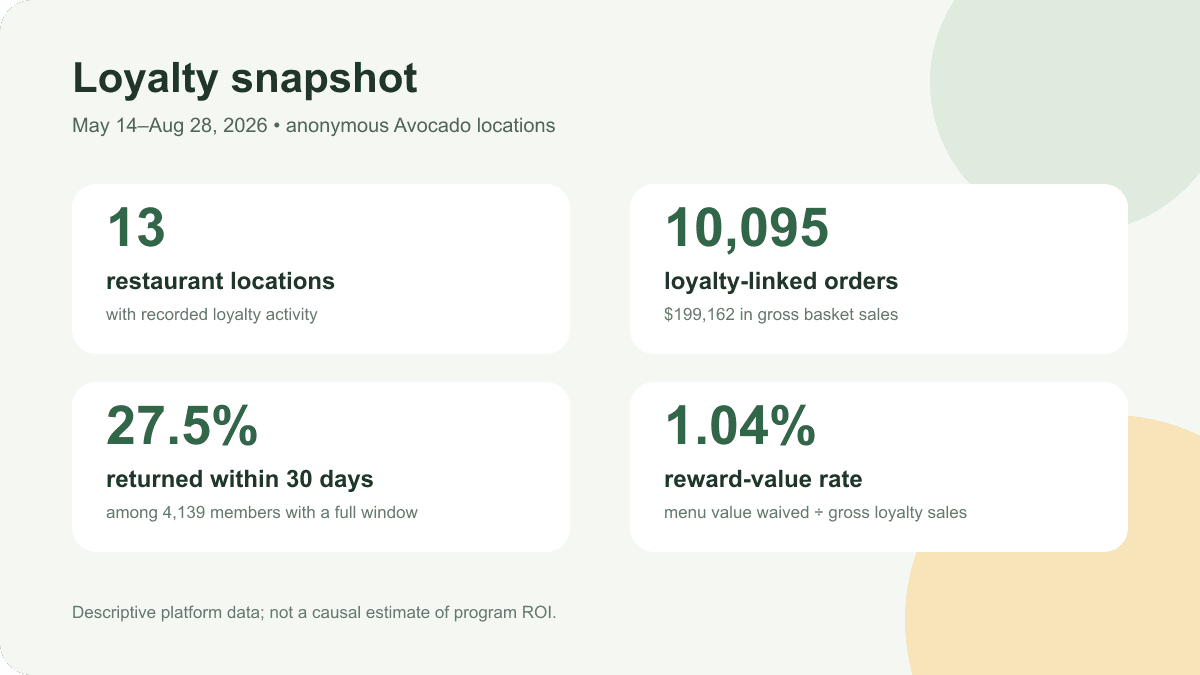
The study period ran from May 14 through August 28, 2026. “Active member” means a loyalty account that recorded at least one earning or redemption event. A loyalty-linked order is an order referenced by a loyalty transaction.
What the Avocado loyalty data says
More than one in four eligible members returned within 30 days
Of 4,139 members with enough time to complete a full 30-day observation window, 1,140 returned for another loyalty-earning purchase. That is a 27.5% 30-day return rate.
For the 2,367 members with a complete 60-day window, 972 returned within 60 days. That is a 41.1% 60-day return rate.
Those are useful operating benchmarks, but they do not tell us how many customers would have returned without the program. A restaurant needs a baseline or control group before calling the return rate incremental.
The recorded reward value was small relative to loyalty sales
Across the full cohort, restaurants recorded $2,076 in menu value waived on $199,162 in gross loyalty-linked basket sales. The aggregate reward-value rate was 1.04%.
Among the 11 locations with at least 20 loyalty-linked orders, the median location recorded reward value equal to 0.65% of gross loyalty sales. The middle half ranged from 0.12% to 1.59%, and nine of the 11 locations were below 2%.
This is not the same as reward cost. A free item with a $10 menu price may cost the restaurant $3 in ingredients. Positive ROI should use the actual food and packaging cost, not the menu price, while the menu value remains useful for understanding how much revenue was waived.
Members repeated more often, but that does not prove the program caused it
We also examined seven locations that each had at least 50 identified member orders and 50 identified nonmember orders. At the median location, 50.9% of members placed at least two orders during the available program window, compared with 9.0% of identified nonmembers.
That difference is large, but it contains selection bias. A restaurant’s best regulars are often the first people to enroll in loyalty. The raw comparison mixes the effect of the program with loyalty that already existed.
The median location’s member-versus-nonmember average-order-value difference was -3.4%. In other words, members did not automatically spend more per transaction. The potential economic value appears more likely to come from repeat visits than a larger check.
That pattern is consistent with the way restaurant loyalty is normally evaluated. Deloitte highlights visit frequency, share of wallet and check size as core measures, and reports that many restaurant loyalty members use their memberships several times per month or week. Read Deloitte’s restaurant loyalty research.
How to calculate restaurant loyalty program ROI
A useful restaurant loyalty program ROI calculation has four parts:
Estimate incremental revenue: revenue from visits that probably would not have happened without the program.
Convert revenue to contribution profit: multiply incremental revenue by the restaurant’s contribution margin.
Add every program cost: reward food cost, packaging, software, marketing and incremental staff time.
Compare the profit with the cost: calculate the return as a percentage of total program cost.
Incremental contribution profit = incremental revenue × contribution margin
Restaurant loyalty ROI = (incremental contribution profit − total program cost) ÷ total program cost × 100
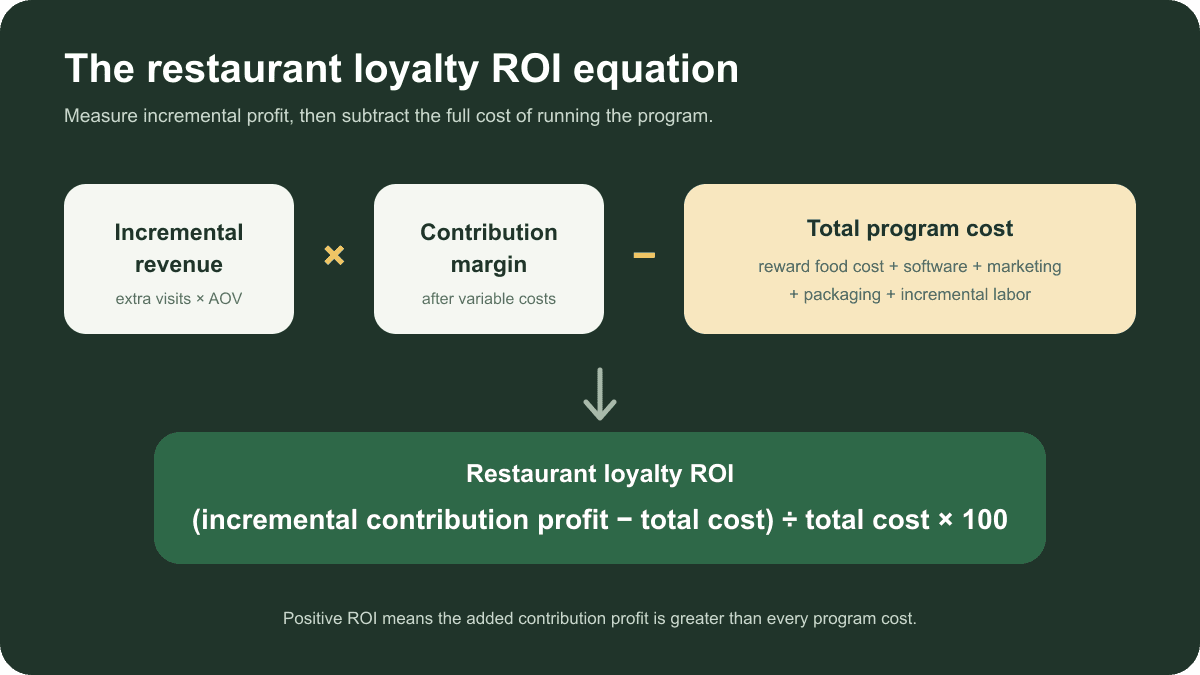
This framing is similar to other loyalty ROI methods that compare incremental profit with total program cost. Talon.One’s restaurant loyalty ROI guide also warns that a simple member-versus-nonmember comparison can overstate results because high-value customers self-select into programs.
A worked restaurant loyalty ROI example
Imagine a restaurant with 400 active loyalty members. After comparing members with a matched historical baseline, the restaurant estimates that the program generated 60 additional visits during the month.
Input | Example |
|---|---|
Incremental visits | 60 |
Average order value | $22 |
Incremental revenue | $1,320 |
Contribution margin | 35% |
Incremental contribution profit | $462 |
Reward food and packaging cost | $75 |
Software, marketing and labor | $100 |
Total program cost | $175 |
The program profit is $462 minus $175, or $287. The ROI is $287 divided by $175, which equals 164%.
The answer changes quickly if the incremental visits are overestimated. If only 20 of the 60 visits were truly incremental, the same program would produce $154 in contribution profit before program costs and would have negative ROI. The baseline is the most important number in the calculation.
The loyalty metrics that actually matter
Metric | How to calculate it | Why it matters |
|---|---|---|
Enrollment rate | New members ÷ eligible identified customers | Shows whether the offer and signup flow are clear |
Activation rate | Members who make another purchase ÷ enrolled members | Separates signups from actual behavior |
Incremental visit frequency | Member visit change minus matched baseline change | Usually the main revenue mechanism |
30/60/90-day retention | Members who return in the window ÷ eligible cohort | Shows whether the program builds a habit |
Average order value | Gross basket sales ÷ completed orders | Checks whether rewards change ticket size |
Effective reward rate | Reward cost ÷ loyalty sales | Shows how much margin the program consumes |
Redemption rate | Rewards redeemed ÷ rewards issued or earned | Reveals whether rewards are reachable and relevant |
Incremental contribution profit | Incremental revenue × contribution margin | Connects behavior to restaurant economics |
Program ROI | (Incremental contribution profit − cost) ÷ cost | Answers whether the program is worth funding |
Do not optimize enrollment in isolation. A program can produce thousands of signups and still fail if members never return or if rewards consume more margin than the additional visits create.
How to measure whether your loyalty program is working
1. Establish a baseline before changing the program
Use at least 60 to 90 days of customer-level history. Record visit frequency, average order value and contribution margin before enrollment. If your concept is highly seasonal, compare the same period from the prior year or use a longer baseline.
2. Track cohorts by enrollment month
Put customers into monthly cohorts and measure whether they return within 30, 60 and 90 days. A single all-time repeat rate makes a new program look artificially weak because recent members have not had time to return.
3. Build a fair comparison group
Match nonmembers to members based on restaurant, prior visit frequency, prior spend, ordering channel and customer tenure. Compare how both groups change over the same dates.
A stronger option is a staged rollout. Launch the program at some similar locations before others, or test a new reward with a randomly selected customer group. That creates a cleaner estimate of incremental behavior.
4. Use contribution margin, not sales alone
An extra $1,000 in sales is not $1,000 in profit. Subtract food, packaging, payment and other variable costs. Then subtract the actual cost of rewards and the operating cost of the program.
5. Separate reward value from reward cost
Track both numbers. The guest may perceive a $12 reward, while the restaurant spends $3.50 on ingredients and packaging. The menu value helps explain customer motivation; the cost belongs in the ROI formula.
6. Review the program every month for at least 90 days
A monthly review should include new members, activated members, 30/60/90-day retention, visit-frequency lift, average order value, rewards earned, rewards redeemed, reward cost and estimated ROI.
Use the same discipline you would apply to restaurant menu engineering: define the measurement period, use consistent data and avoid changing several variables at once.
Signs your restaurant loyalty program may have positive ROI
Visit frequency improves relative to a matched baseline.
More members return within 30, 60 and 90 days.
The effective reward-cost rate stays within the margin the added visits create.
Members remain active after the first reward is redeemed.
The program produces contribution profit after software, marketing and labor.
The results persist across several cohorts rather than one promotion.
Warning signs the loyalty program is losing money
Enrollment grows, but very few members make a second purchase.
Rewards become more generous while visit frequency stays flat.
The program mostly discounts purchases from customers who already visited frequently.
Redemptions cluster on low-margin or operationally difficult items.
The restaurant reports revenue lift without subtracting reward or food cost.
No one can explain how the nonmember baseline was selected.
These are operating signals, not universal industry thresholds. The right reward rate for a coffee shop, taco truck and full-service restaurant will differ because their visit patterns, average checks and margins differ.
Study methodology and limitations
The Avocado Data Lab analyzed loyalty activity recorded from May 14 through August 28, 2026. The cohort included 13 anonymous restaurant locations with at least one loyalty earning event.
The analysis included:
5,569 loyalty accounts with at least one earning or redemption event
10,095 distinct orders referenced by a loyalty transaction
$199,162 in gross basket sales on those orders
$2,076 in recorded menu value waived through loyalty rewards
For the 30-day return calculation, we included only the 4,139 members whose first loyalty-earning order occurred early enough to observe a full 30 days. For the 60-day calculation, we included the 2,367 members with a complete 60-day window.
The location-level reward benchmark included 11 restaurants with at least 20 loyalty-linked orders. The member-versus-nonmember comparison included seven restaurants with at least 50 identified orders in each group. Location medians were used so the largest restaurant did not dominate those comparisons.
The recorded reward value is the menu value waived, not ingredient cost. Avocado did not have complete recipe-cost, incremental labor or external marketing-cost data for every restaurant, so the study does not calculate a single platform-wide ROI.
The data is observational. Loyalty members may differ from nonmembers before enrollment, and some restaurants imported existing loyalty customers from another system. Raw differences should be treated as associations, not proof that the program caused the outcome.
The cohort is young, small and not representative of every U.S. restaurant. Treat these results as an early benchmark for independent restaurants using Avocado, not a national census.
Frequently asked questions
Are restaurant loyalty programs worth it?
A restaurant loyalty program is worth it when incremental contribution profit from additional visits exceeds reward, software, marketing and labor costs. Enrollment and member revenue alone are not enough to prove positive ROI.
How do you calculate restaurant loyalty program ROI?
Estimate incremental revenue using a matched baseline, multiply it by contribution margin, subtract all program costs, and divide the remaining program profit by total program cost. Multiply by 100 to express ROI as a percentage.
What is a good restaurant loyalty redemption rate?
There is no universal ideal redemption rate. A healthy rate depends on reward structure, margin and visit frequency. Track whether redemptions lead to incremental profitable visits and whether the reward-cost rate remains sustainable.
Do loyalty members spend more?
Not always. In the Avocado cohort, the median location’s member-versus-nonmember average-order-value difference was -3.4% among seven qualifying locations. The stronger observed difference was repeat behavior, although that comparison is affected by customer self-selection.
How long should a restaurant test a loyalty program?
Run the program for at least 90 days before making a broad ROI judgment, while reviewing monthly cohorts along the way. Concepts with seasonal demand or low visit frequency may need six to 12 months.
Should reward cost use menu price or food cost?
Use actual food and packaging cost in the ROI calculation. Track menu value separately because it represents the value communicated to the customer and the revenue waived at redemption.
The bottom line
The early Avocado data suggests that restaurant loyalty programs can create meaningful repeat behavior without giving away a large share of loyalty-linked sales. Across 10,095 orders, 27.5% of eligible members returned within 30 days, 41.1% returned within 60 days and recorded reward value represented 1.04% of gross loyalty sales.
Those are encouraging signals, not proof of positive ROI. The decisive question is how many visits were truly incremental and how much contribution profit those visits produced after every program cost.
Measure the baseline, use mature cohorts, calculate actual reward cost and judge the program on incremental contribution profit. That is how you tell whether restaurant loyalty is building a profitable habit or simply discounting customers who were already coming back.
Avocado connects loyalty activity with restaurant orders and reporting in one system. Book an Avocado demo to see how your repeat-customer data can become a measurable loyalty program.